
- 02/05/2026
- Dr. Srivatsan Gurumurthy
- 0 Comments
- Blog
Sports Hernias: Why Athletes Get Them and How to Recover?
Athletes push their bodies every day. They train hard, compete strongly, and often ignore pain. But one injury that is commonly missed is a sports hernia. It may not look like a normal hernia, but if not treated on time, it can affect an athlete’s career badly.
If you are an athlete having groin pain, you are not alone. Many sportspersons in India face this problem. The good thing is that proper treatment is available.
Dr. S. Srivatsan Gurumurthy, a leading hernia specialist in Chennai, has helped many athletes recover well and return to their sport with confidence.
What Is a Sports Hernia?
A sports hernia is not exactly like a regular hernia. It does not create a visible bulge. Instead, it is a tear or strain in the soft tissues of the lower abdomen or groin area.
The medical term for this condition is athletic pubalgia. It affects the muscles, tendons, and ligaments that stabilise the pelvis. When these tissues get torn, they cause sharp, persistent groin pain.
Unlike a common hernia, this injury rarely causes an organ to push through the muscle wall. However, it is just as painful — sometimes more so.
Why Do Athletes Get Sports Hernias?
Sports hernias happen because of repeated stress on the groin area. Certain movements put extreme pressure on the lower abdominal muscles. Here are the most common causes:
- Sudden twisting or turning movements — common in football, cricket, and tennis
- Kicking motions — especially in football and martial arts
- Sprinting and rapid change of direction — seen in hockey and basketball
- Overtraining without adequate rest — breaks down muscle tissue faster than it heals
- Weak core muscles — places more strain on the groin region
Athletes involved in high-impact sports are at the highest risk. Young athletes who increase their training intensity too quickly are also vulnerable.
Symptoms You Should Never Ignore:
Sports hernias can be tricky. The pain may come and go at first. But over time, it gets worse. Here are the warning signs:
- Sharp groin pain during physical activity
- Pain that eases at rest but returns during exercise
- Tenderness in the lower abdomen or groin
- Pain when coughing, sneezing, or bending
- Discomfort while sitting up from a lying position
If you notice these signs, please see a doctor immediately. Early diagnosis makes recovery much faster.
How Is a Sports Hernia Diagnosed?
Diagnosis requires clinical examination and imaging. A skilled gastroenterologist in Chennai or hernia specialist will review your medical history, physical activity, and perform a thorough physical exam.
Imaging tests like MRI are the gold standard. They can clearly show tears in soft tissues that X-rays cannot detect. Sometimes ultrasound is also used to check for structural abnormalities.
Dr. S. Srivatsan Gurumurthy takes a thorough, personalised approach to each patient. He combines clinical expertise with advanced diagnostic tools to ensure an accurate diagnosis.
Treatment Options for Sports Hernias:
1. Conservative Treatment:
For mild cases, conservative management is tried first. This includes:
- Rest and activity modification
- Physiotherapy and targeted exercises
- Anti-inflammatory medications
- Core strengthening programmes
This approach works well for minor soft tissue injuries. However, if pain persists beyond six to eight weeks, surgery is usually recommended.
2. Laparoscopic Hernia Surgery — The Preferred Choice:
When surgery is needed, laparoscopic hernia surgery in Chennai is the most preferred method. It is minimally invasive. The surgeon makes tiny cuts and uses a camera to repair the torn tissue.
The benefits of laparoscopic surgery are:
- Smaller incisions and less scarring
- Less post-operative pain
- Shorter hospital stay
- Faster return to sport
Lower risk of complications
3. Robotic Hernia Surgery — The Future of Precision:
For complex or recurrent cases, robotic surgery is the best option. As a highly trained robotic surgeon in Chennai, Dr. S. Srivatsan Gurumurthy uses the da Vinci Surgical System to perform precise repairs with unmatched accuracy.
Robotic surgery offers enhanced 3D vision, greater instrument flexibility, and better control in tight spaces. As a trusted robotic hernia surgeon in Chennai, Dr. S. Srivatsan Gurumurthy delivers outstanding results with minimal downtime.
Recovery: What to Expect After Surgery?
- Week 1–2: Rest, wound care, and gentle walking. Avoid strenuous activity.
- Week 3–4: Begin physiotherapy. Focus on core and hip strengthening.
- Week 5–8: Gradual return to sport-specific training under supervision.
- Week 8–12: Full return to competitive sport, if cleared by the surgeon.
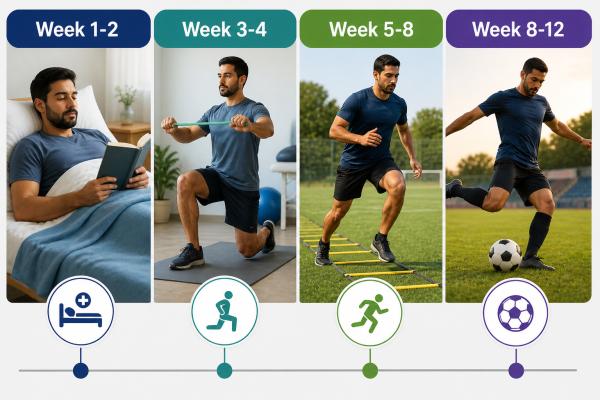
Patients who undergo hernia repair treatment in Chennai under Dr. S. Srivatsan Gurumurthy follow a well-planned recovery protocol. This ensures long-term success and prevents recurrence.
Preventing Sports Hernias: Tips for Athletes
Prevention is always better than cure. Here are some practical tips to protect your groin and lower abdomen:
- Strengthen your core regularly. A strong core reduces groin stress.
- Warm up thoroughly before every session.
- Increase training intensity gradually. Avoid sudden spikes.
- Stretch the hip flexors and adductors consistently.
- Listen to your body. Pain is a warning signal — do not ignore it.
Why Choose Dr. S. Srivatsan Gurumurthy?
Dr. S. Srivatsan Gurumurthy is a Senior Consultant Surgical Gastroenterologist with over 17 years of experience. He is the Clinical Lead for Advanced Laparoscopic and Robotic GI Surgery at Apollo Super Speciality Hospital, Teynampet, Chennai.
He holds an MS in General Surgery, DNB in GI Surgery, FMAS, and FMIAS. He has published 34 research papers in international journals. He has presented at world-class conferences in Seoul, Geneva, and Mumbai. He has been invited as a live surgery faculty at multiple national and international conferences.
His expertise spans robotic and laparoscopic surgeries for the stomach, colon, pancreas, liver, and hernia. As one of the most trusted names in hernia repair treatment in Chennai, he delivers world-class surgical care right here in Tamil Nadu.
Conclusion:
Sports hernias are painful, but they are treatable. With the right medical care, athletes can make a full recovery and return to peak performance.
Do not delay treatment. The earlier you get help, the faster your recovery. Consult Dr. S. Srivatsan Gurumurthy today for expert advice on sports hernia management.
📍 Book Your Consultation Today:
- Address: Apollo Super Speciality Hospital, 320, Anna Salai, Teynampet, Chennai – 600035
- Address: SS Surgical Clinic, 2nd Main Rd, CIT Colony, Mylapore, Chennai – 600004
- phone: 96772 31111
- Email: drsrivatsan12@gmail.com
- Website www.drsrivatsan.com
- Time: Mon to Sat: 8 AM – 5 PM